Håfa Adai! Especially during this period of visitor industry recovery, it is incumbent upon anyone with a stake in our inter-island economy to practice, preserve, and promote our priceless CHamoru culture. Our very livelihoods depend upon it.
Our 4,000-year-old language and way of life are not only Guam’s chief differentiators as a destination of choice, but “i kottura” is literally and figuratively the breadbasket of the whole Marianas archipelago and has always attracted visitors to Saipan, Tinian, and Rota.
The ancient, adventurous, pioneering aspects of espiritun CHamoru have also drawn more outdoorsy types into the CNMI’s “Northern Islands” district, including the likes of Agrigan, Anatahan, and Pagan islands. These ancient haunts are either uninhabited or sparsely inhabited and largely untouched by human contact. Way up north is where CHamoru and Carolinian survival skills are taught in an atmosphere of “trial by fire” and put to the most demanding test!
But nowhere is our CHamoru heritage more inviolably retained and ingrained than in i islan Luta, the island of Rota, the southernmost landfall of the Commonwealth of the Northern Mariana Islands. And to the Guam Visitors Bureau’s everlasting delight, Rota is the Northern Mariana Island that sits closest to the U.S. territory of Guam.
We have good reason to be enamored by our neighbor to the north. Unblemished Rota, once known as “Zarpana,” is the trifocal glass through which we most profitably behold, filter, and practice the CHamoru arts.
A cultural repository
Above all other Mariana Islands, including Guam, in many ways Rota is the ultimate keeper of the CHamoru identity. This is true from the practical everyday rhythm, depth, and authenticity of its indigenous people’s spoken vernacular to their culturally intrinsic, sustainable use of the island’s unspoiled flora, fauna, land, and surrounding seascape.
Bisita!
So, imagine our delight when Rota Mayor Aubry Hocog stopped by the GVB offices a little over a month ago, just to learn a few marketing and promotional ideas by picking up some collateral materials and asking our marketing division for tips. Are you kidding me? We should’ve been asking Mayor Hocog for advice on cultural authenticity!
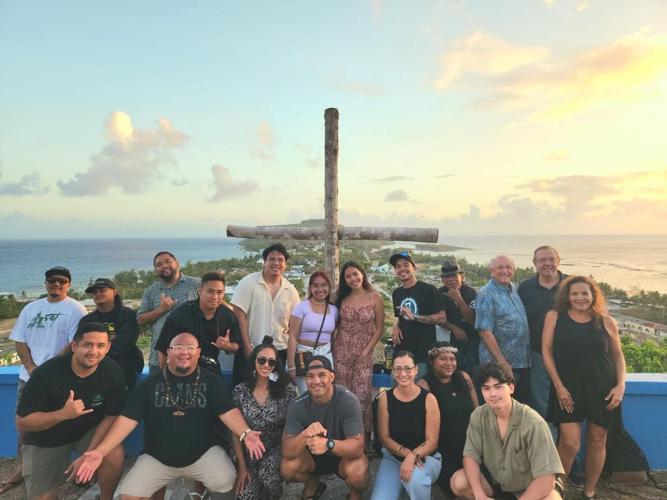
When I learned of her visit, I joined the meeting right away and was deeply moved by Mayor Hocog’s humility as well as her passion for breathing fresh new life into Rota’s economy. This soon led to our familiarization tour of the Friendly Island earlier this month.
Local historian, guide, and cultural practitioner Ben “Guelo” Rosario led the tours, along with his brother, Antonelli “Ton” Rosario from the Historic Preservation Office, and David Santos, an accomplished Rota native who works for the CNMI’s Governor’s Office. All three of these capable gentlemen were magnanimous, knowledgeable, kind, and hospitable.
Mayor Hocog’s right hand, Dina Songao, also made sure we were all taken care of and performed an abundance of legwork and logistics for our itinerary. The Department of Fire and Emergency Medical Services even accompanied us on every outing to make sure we were safe. We thank everyone for an insightful, hazard-free, enjoyable trip!
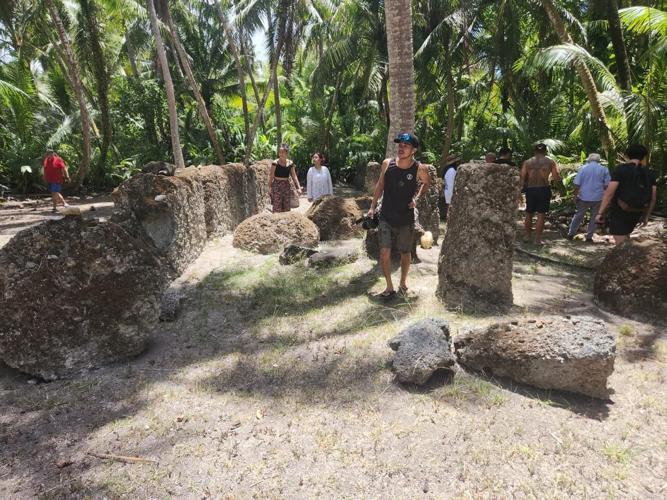
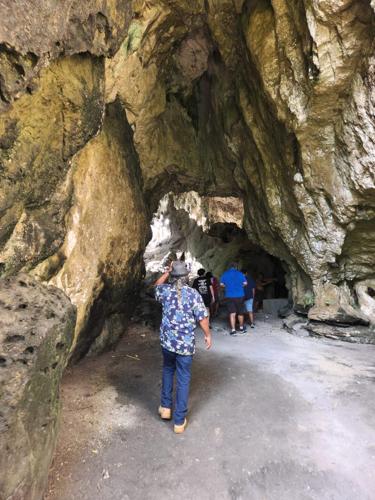
Our Guam contingent toured Rota’s historical and natural hotspots, including the scenic I’Chenchon Park Bird Sanctuary and Alaguan Bay; the ancient Mochong latte stone village, the coastal Agusan Swimming Hole, and the largest banyan tree in the Marianas.
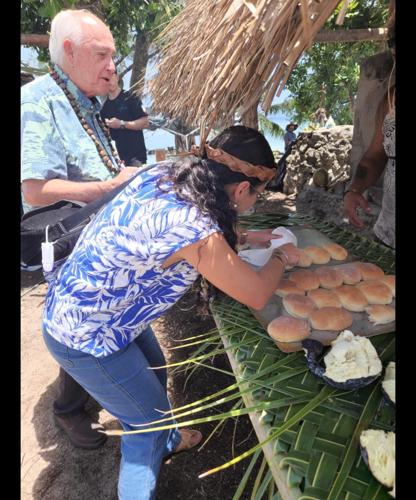
We experienced nighttime crab catching and deer hunting and took in traditional customs, cuisine, artwork, music, and dance.
Sustainable “spot-only” fruit bat hunting and catch-and-release coconut crab hunting are promising pastimes in Rota, since there are plenty of local experts who can monetize these activities for visitors.
Imagine how rejuvenated a city-weary Japanese couple would feel setting ponne or tåhu coconut baits, then returning with flashlights to pick up crabs before midnight, or walking the reef flats looking for lobsters under cover of darkness.
This is eco-tourism at its most basic level. It’s exhilarating, cost effective, sustainable, and lucrative. These kinds of activities could grow into a cottage industry for families in Rota. Southern Guamanians take note!
The island way
We received red carpet treatment and first-class hospitality every step of the way from the neighborly Rota community, inclusive of many businesses operating there. Star Marianas Air, TJ Enterprises, Kin & Rit, Inc., Tan Holdings Corpl, PJM Enterprises, As Paris Restaurant, Puesto Grill, Tokyo En Restaurant, Calvo Enterprises, Inc., Blue Palms Dive Service, and Rota Cave Museum all treated us as welcome guests.
Although the island features a few small hotels and a handful of restaurants, some guest amenities are closed indefinitely due to the economic hardship of late. Be that as it may, home-owning locals are more habituated to growing, preparing, and consuming fresh “whole food” delicacies and traditional living in Rota, anyway.
What’s more, Friendly Islanders are delighted to share the fruits of their bounty with visitors who discover the calming allures of Rota’s Sinapalo and Sonsong villages, the verdant magnificence of its Wedding Cake Mountain (Mt. Taipingot), or the mystery of the “never excavated” largest capstones ever discovered in the Marianas, at As Nieves Latte Stone Quarry.
GVB sends its sincerest gratitude to the people of Rota for hosting us and showing us the incredible natural beauty of their glorious island and all the special ways i taotao ginen Luta take care of it!
Extra shoutouts to Mayor Hocog’s staff, Sen. Donald Manglona, the Rota Municipal Council, Rota Chamber of Commerce, Marianas Visitors Authority, CNMI Department of Community and Cultural Affairs, and the CNMI Department of Land and Natural Resources.
From my perspective
As many of you know, I am a born-and-bred “wartime Guam” CHamoru who grew up learning the rich Marianas traditions of hunting, fishing, farming, ranching, cooking, and social gathering from elders who knew our way of life before the three-year Imperial Japanese occupation and Battle of Guam.
Our forebears trebled their survival instincts and traditional methods of living with the innate CHamoru trait of adaptability, so their children could thrive on the other side of war without forgetting their roots.
Although Rota was occupied, farmed, and excavated by Imperial Japanese interests mostly during the last few seasons of the Land of the Rising Sun’s 30-year reign over the Northern Marianas, the island itself was not a major WWII battleground. Nor was it a primary launching pad for U.S, military maneuvers that turned the Pacific Theater to America’s advantage.
Rather, Hispanicized CHamoru prewar life was arguably less disturbed during and after “war and occupation,” due to limited battle-era engagement.
And this is an abundant blessing to Saipan, Tinian, and Guam. For it is my humble but informed opinion that Rota soon became the living, breathing institution of our least-touched “CHamoru culture intact,” and remains precisely that to this very day.
Therefore, Rota deserves special attention among our most ardent efforts to carry on the traditions of yore through every modern or ancient means within our grasp. With each of us, let the renaissance begin – whether it be in the simple act of smiling and waving at more of our fellow guests and passers by, just like Friendly Islanders are famous for doing, or devoting more of our time to language learning and cultural immersion.
In fact, certain leaders from Rota have expressed a heartfelt desire to formalize culture camps to teach Guamanians more about the prewar ways that have endured on that 1,800-person island in spite of the modernization that has swept over all of Micronesia since the Second World War.
And bula taotao ginen Luta (many people from Rota) are eager for their island to become an optional tour for Guam’s growing number of visitors. I say, “na’i animu!” What blesses one, blesses all! GVB welcomes the challenge!
The traditional prewar arts of talåya fishing, hunting, gathering, palm frond weaving, “hotnu” oven baking, animal husbandry, and preserving the CHamoru cookbook are worth every effort to practice and perfect. We should also continue to do our utmost to retain and preserve artifacts, even if doing so sometimes entails the reclamation and return of treasures lost to outside interests.
GVB’s familiarization tour of the “Friendly Island” of Rota served as a stark reminder of how critical the rapidly evolving “One Marianas” mission must remain in the months and years ahead.
It was a wakeup call for Saipan, Tinian, Rota, and Guam—the permanently inhabited islands of the Marianas archipelago that depend on a thriving visitor industry to keep standing on our own feet—that we must rely on one another for solutions and support in the development of new air routes, refurbished attractions, and reopened guest quarters.
Fascinating as our Friendly Island exchange was for everyone involved, it was also a subtle admonition that the consistent practice, preservation, promotion, and presentation of our generous CHamoru folkways must be the glue that holds us together as a people.
The shocking reality of U.S. armed forces and military contractors hardening defenses across the Marianas and Micronesia is necessary for the protection of our shared liberty. It is also a cultural invasion that comes at a steep price. And it will be up to island people to ensure that our cultures stay intact.
View the article: https://www.saipantribune.com/opinion/columnists/rota-gateway-to-i-kottura/article_d70ff76e-1cd7-11ef-b2f3-3373300484c3.html